Health and Safety Policy for Flat Clearance Turnham Green
 Purpose and commitment: This policy sets out the approach this flat clearance operation takes to protect the health, safety and welfare of employees, contractors, residents and members of the public during flat clearance and rubbish removal activities. The aim is to deliver safe, efficient apartment clearance services while minimising risk to people and the environment. The company recognises that a structured safety management system and proactive leadership are essential to safe waste removal operations.
Scope: This policy covers all aspects of the clearance service including initial site assessment, removal of household and commercial waste, handling of bulky items, recycling and disposal arrangements, and interaction with tenants or property managers. It applies to all staff involved in clearance, drivers, operatives, subcontractors and anyone attending premises on behalf of the clearance team.
 Responsibilities: Management has overall responsibility for ensuring compliance with this policy and providing resources. Site supervisors and team leaders are responsible for implementing safe systems of work during rubbish clearance. Employees and contractors must follow safe methods, report hazards, and use provided personal protective equipment. Strong emphasis is placed on communication: job briefings must be carried out before every clearance job and changes to scope must be reassessed.
Risk assessment and planning: Each clearance assignment begins with a documented risk assessment focusing on manual handling, working at height, sharps, contaminated waste, asbestos risk, and traffic management for removal vans. The assessment identifies control measures such as safe lifting techniques, use of trolleys and hoists, and segregation of hazardous items. Where necessary, specialist removal or licensed disposal contractors will be engaged for hazardous or regulated waste.
 Safe systems of work: Operatives must follow standard procedures for rubbish removal services, including establishing exclusion zones, using correct lifting aids, and maintaining clear access routes. Electrical items will be cordoned separately and assessed for recycling. All bulky furniture moved through communal areas must be protected to avoid damage. The company enforces speed limits and parking controls for service vehicles to reduce site risk.
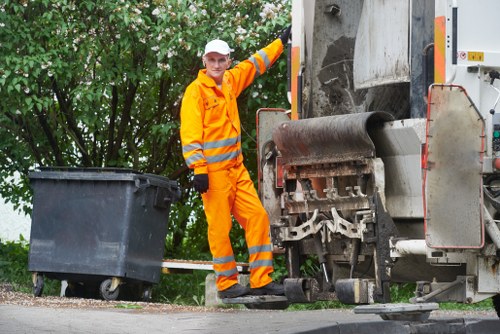
Personal protective equipment (PPE): Appropriate PPE, such as gloves, hi-vis clothing, safety boots, eye protection and respiratory protection when required, will be provided and maintained. Staff must inspect PPE before use; any damaged gear must be replaced. Training on correct PPE selection and use forms part of induction and periodic refresher training for the clearance crew.
Manual handling and equipment: Training in safe lifting and mechanical assistance is mandatory. The policy encourages use of wheeled equipment, lifting straps, and mechanical hoists for heavy or awkward loads to prevent musculoskeletal injuries. Regular maintenance of vehicles, tail lifts and moving equipment is scheduled and recorded. The company promotes proactive reporting of near-misses to continuously improve handling procedures during flat and apartment clearance jobs.
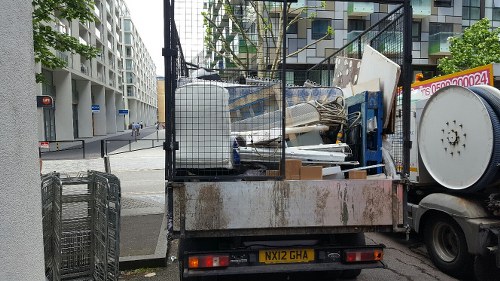
 Hazardous materials and contamination: Any items suspected of containing hazardous substances—such as asbestos, chemical containers, medication waste, or sharps—must be reported and isolated. Only trained personnel or approved contractors will handle these materials. Waste segregation procedures ensure that recyclable, reusable and hazardous streams are separated, labelled and transported to appropriate facilities in compliance with waste transfer requirements.
Emergency procedures and first aid
Emergency response arrangements include on-site first aid provision, clear reporting lines, and access to emergency services. All teams carry a basic first aid kit and are trained in emergency response relevant to clearance activities. Incidents are recorded, investigated and lessons learned are communicated to the workforce to prevent recurrence.Training, competence and records
The company ensures operatives are competent through formal induction, job-specific training and periodic refresher courses. Training records, risk assessments, vehicle and equipment maintenance logs and incident reports are retained and reviewed. Competence extends to safe driving, vehicle loading, manual handling and environmental awareness during house or flat clearance tasks.Monitoring and review: Regular site audits, toolbox talks and supervisor inspections are used to monitor compliance. Performance indicators include incident rates, near-miss reporting frequency and audit findings. This policy is reviewed at least annually or after significant incidents, changes to operations, or regulatory updates affecting waste removal and clearance services.
Core commitments:
- To protect staff and the public through effective risk control and safe work methods.
- To manage waste responsibly, prioritising reuse and recycling where practicable.
- To ensure all flat clearance and rubbish removal activities are conducted lawfully, safely and sustainably.